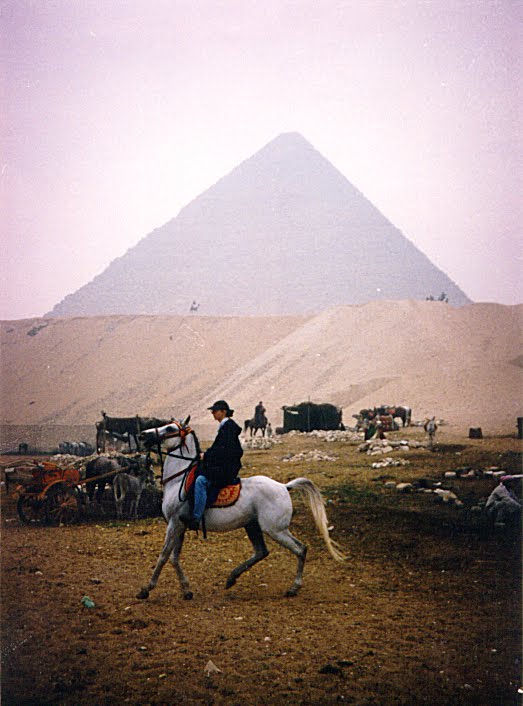
Christmas in Cairo, 1993 (Photo by Kacey Dewing)
I am intensifying my search for an agent and/or publisher, and am using this as a place to list the links for my stories (excerpts from two novels) which have been published.
The genre is creative non-fiction (a.k.a. true stories). These were all published in a handful of issues of Mused--Bellaonline Literary Review.
[Following are excerpts from Below Sea Level, novel about 10 years with husband suffering from Borderline Personality Disorder]
Shadow of the Mountains
Dog Day Afternoon*
Goodyear
Cycles
*Personal favorite
[Excerpt from The Agoraphobic's Guide to Cairo, about my year abroad in Cairo, Egypt in 1993-94]
Al-Abyaad - The White One (About the horse who did not kill me.)
-----------------------------------
Interview:
Nancy Dietrich: In Her Own Words
Further unpublished excerpts can be found on this blog:
Kickback from Below Sea Level
Painting the Town Blue from Below Sea Level
Al-Qitta (The Kitten) from The Agoraphobic's Guide to Cairo
Bustan al-Hayawanat (The Zoo) from The Agoraphobic's Guide to Cairo
Any suggestions appreciated. Thank you.
Read more!
Sunday, October 23, 2011
My Stories and Published Novel Excerpts
Thursday, April 28, 2011
My Published Stories/Novel Excerpts
Christmas in Cairo, 1993 (Photo by Kacey Dewing)
I am intensifying my search for an agent and/or publisher, and am using this as a place to list the links for my stories (excerpts from two novels) which have been published.
The genre is creative non-fiction (a.k.a. true stories). These were all published in a handful of issues of Mused--Bellaonline Literary Review.
[Following are excerpts from Below Sea Level, novel about 10 years with husband suffering from Borderline Personality Disorder]
Shadow of the Mountains
Dog Day Afternoon*
Goodyear
Cycles
*Personal favorite
[Excerpt from The Agoraphobic's Guide to Cairo, about my year abroad in Cairo, Egypt in 1993-94]
Al-Abyaad - The White One (About the horse who did not kill me.)
-----------------------------------
Interview:
Nancy Dietrich: In Her Own Words
Further unpublished excerpts can be found on this blog:
Kickback from Below Sea Level
Painting the Town Blue from Below Sea Level
Al-Qitta (The Kitten) from The Agoraphobic's Guide to Cairo
Bustan al-Hayawanat (The Zoo) from The Agoraphobic's Guide to Cairo
Any suggestions appreciated. Thank you.
Read more!
Monday, June 21, 2010
New Season--New Story

Summer. Sprawl on the hammock and soak up the richness of Mused. A stroke-affected woman struggles to move on. A hospital patient finds strength to make a choice. Depression, loneliness, angst-filled remembrances - and also hope, longing, spell binding beauty.
Images nestle you in the hills of Sicily, walk with you along the Great Wall of China. Thunder with a horse in full gallop, rest with a pelican by the water, and share the tiny world of a ladybug. Feel peace with the mountains of the Grand Tetons. [Can't wait to read this one!! Not mine!]
Fiction stories send us back to a childhood of boiling crabs and avocado-green appliances. They muse about angels and peer into overflowing inboxes, full of curiosity.
Non-fiction shakes up our view of the world. Recovering from a breakup. Galloping full tilt across a Cairo desert. [That would be mine...]
Al-Abyaad - The White One
Nice break from oil, anyway.
Friday, February 12, 2010
Al-Qitta [The Kitten]
 Cocoa in Salt Lake City, UT in 1997
Chapter Three from The Agoraphobic's Guide to Cairo. This was originally posted here on May 26, 2008, on the 5th anniversary of Miss Cocoa's disappearance/death. This version was slightly edited for submission to Mused. They're not using it so I'm free to re-post.
************************************************
You could read the temperature in the faces of the young, underfed security guards draped at the entrance of the American University of Cairo (AUC) as I left my classes one early September afternoon in 1993. Melting in their white wool uniforms of summer, they did not have the strength to stand without leaning on their Kalashnikovs. I returned their drowsy nods as I passed their makeshift post of wood and cardboard. I had only been in the country for a month, but already I was not ready to face my new home across the Nile with nothing but several hours of Arabic homework to pass the long evening hours. My newly-married American roommates lived a fairly self-contained existence. The last thing they needed was a new roommate complaining about being lonely. So rather than hailing one of the million or so black-and-white taxis filling the streets, I headed east down Mohammed Mahmoud Street.
Thousands of Egyptians, a few Americans and others of all nationalities shared the broken and uneven sidewalks. The overflow, and those in a hurry, strode with purpose in the road itself, on the bank of a stream of ever-moving traffic, where they were uninterrupted by the ankle-wrenching breaks found everywhere in the “regular” sidewalk. My goal was the AUC library, filled with books I could only read achingly slowly, if at all. Just a few days before, I had dared myself to seek out the Arabic translation of Tolstoy’s “War and Peace.” I found it easily enough on the well-organized shelves and pulled it out to run my eyes over the first few paragraphs. After a minute or so, I gently closed the leather-bound cover and replaced it on the shelf. I acted in a deliberate manner such that anyone watching me might have imagined that was all I had really planned to do, anyway. Two and a half years of Arabic may have been enough to help me find the book, but it was not enough to get me much further than that. Baby steps, I decided. “Al-Harb wa al-Salaam” would have to wait.
But I never made it to the library. Instead I found myself drawn through the crowd towards a small shop—more like a dark hole between shops—I had noticed while exploring some days before. Next to the nearby sundries store, where my daily Cadbury bar awaited me, this store would prove to hold my greatest temptation yet.
Stepping out of the flowing crowd, I paused at the window of the small shop. I was immediately transfixed by a white Siamese kitten imprisoned in a ten-gallon fish tank. The rays of the sun drove through the outer window of the store through the glass of the tank without mercy, creating an Easy-Bake Oven within. Flies buzzed around a small bowl of rancid strawberry yogurt. Two enormous, aquiline orbs dominated the perfectly round head of the highly indignant occupant. Her face strained with the effort she had summoned to proclaim the injustice of her condition, and her bright red tongue was a pointed exclamation point on each terrible scream—all of which were completely muted to the outside world by double layers of glass. To this fierce feline, escaping that tank was not an empty hope: it was a foregone conclusion.
A young clerk spotted me from the cool, dark recesses of the store and moved instantly in my direction. I quickly assumed a confident air of indifference, looking around as if I might, at any moment, step back into the stream of the passing population. To this day, I am convinced he was completely and utterly deceived by my calculated actions. I nodded wordlessly in the direction of the fish tank.
“Twenty pounds,” he stated in English. [Roughly $7 USD]
“It is a half-dead cat with no tail,” I said, to no one in particular. She was in fact more than half-alive, but I have never been one to shy away from profitable exaggeration. In her weepy eyes I could see the beginnings of a typical kitten virus, and her tail—something was seriously wrong with that tail. It traveled only an inch from her body before ending abruptly in a tragic little hook.
Our Egyptian matchmaker stepped briefly behind the store window and scooped up the miserable creature in question. Her cries ceased immediately, but her eyes remained fixed upon mine like two tragic blue moons. She appeared overall as if some hand had rolled her in bleached flour, then carefully and deliberately dipped her paws, ears, tail, and the very tip of her nose in dry cocoa. I had never seen anything so adorable in my entire life. The young man abruptly tilted her nose to the ground to better display her deformed tail.
“It is the highest fashion for the male Siamese to have the shortest tail possible.” He spoke with the firmest authority on feline fashion. Craning her head out of his grasp to keep her eyes locked onto mine, she all but dared me to give this man any reason to lower her back into that stifling aquarium. Something in her eyes suggested she doubted I possessed the power to do so.
Feeling myself drawn deeper and deeper into a discussion with only one possible outcome, I tore my eyes from hers and directly faced her captor. “First of all, the kitten you are holding is female. Secondly, mutilation should never be confused with fashion in a Siamese cat.” When he looked down at her in momentary confusion—which probably had more to do with linguistic barriers than anything else—I saw my window.
“Ten pounds.”
The young man shrugged. He knew when he’d been outsmarted by a wily American tourist. I fished a ten-pound note from the pocket of my jeans and handed it to him in exchange for one cutting-edge female kitten. The pads of her tiny feet felt like soft, fresh marshmallows in the palm of my hand. Her brilliant white coat was as velvety as the lightest chocolate mousse. Her eyes, which seemed to grow only bigger as each minute passed, had never left my face, nor had she ever blinked. I began to wonder if she possessed eyelids. Were Siamese cats without eyelids another bizarre trend I was heretofore unfamiliar with?
Finally, I had someone to pass the long evening with—the long year with—and someone to accompany me home. Knowing I had at least thirty minutes of weaving and riding through traffic to reach my apartment, and having nothing but a burgeoning book bag to transport my new ward in, I begged a small Snickers Ice Cream Bar box off of the store owner and gently placed her inside it. She slid weightlessly to one corner of the box, which I closed as I flagged a passing taxi.
Sitting in the backseat of the typical Cairene cab, one could experience for the first time what it must feel like to be a baked potato. The black roof of a taxi worked even better than aluminum foil to heat its contents. The dry, still air would be just on the verge of taking your breath away when a fresh, hot blast of desert wind mixed with car exhaust would burst through the open windows of the car, carrying just enough oxygen to hold you over until the next breeze. Though nearly every cab I rode in during my stay was brightly decorated with turquoise-colored charms to ward off the evil eye, along with Quranic or Christian sayings (depending on the faith of the driver), it was highly unusual to climb into one that was air-conditioned. It turned out to be just one more cannot-live-without American habit that proved to be unnecessary once you grew accustomed to it.
I may have been getting used to the heat, but I did not want my four-legged ice cream bar to melt before I got home. As we began to work our way through the cars and buses entangling Midan Tahrir, I slowly lifted one corner of the Snickers box to check on her. The instant she caught sight of me the cab was filled with an ear-splitting howl. People passing along the street on foot turned to look in our direction. I give my driver tremendous credit for not driving our vehicle directly into the face of oncoming traffic as his head snapped around to see for himself what wild creature was preparing to rip me—and quite possibly, him—limb from limb in the back of his vehicle. I slammed the lid back down on the box—instantly silencing the protest—just as he looked over and, seeing nothing but a guileless tourist, slowly turned back to face the road. I gave him a reassuring smile in the rear view mirror. It was not returned.
He did not say a word during the entire trip, though he always kept one eye on me and one on the road. I signaled him to stop when we reached my street corner and I handed him about twice the typical cab fare, hoping to buy his silence with a monetary apology. As I juggled my bag, box and loose change, Cocoa pushed her nose through a corner of the box, landing her gaze directly upon my startled driver.
“Fi qitta hinaak?!” [“It’s a kitten in there?”] He said, clearly expecting a Tasmanian devil or something along those lines.
Before I could answer him, she let loose with another earth-shaking howl of protest. At the sound of it, he threw my fare on the seat next to him and shook his head, peeling out of sight. I tucked my friend carefully under one arm and climbed the never-ending stone flights to my fourth floor apartment.

Cocoa Bean, my official new back up, weighed less than a pound when her feet first landed on the polished wood floors of my apartment. She could not have been 6 weeks old. Size, I soon learned, has no bearing whatsoever on vocal strength or lung capacity. I was taught within seconds that she not only knew exactly what she needed from me, and that I would pay a dear price should I deny her. I had not even fully straightened to a standing position after freeing her from her Snickers box when she hit me with her opinion regarding personal space. As far as she was concerned, mine was to include her at all times. I tried to walk slowly from room to room to show her new home, but she stood firmly rooted where I had placed her and just cried. Loudly. So she got her first tour riding on my shoulder. For the first several months, in fact, I could go nowhere in the apartment without Cocoa affixed to my neck or shoulder. If I accidentally left a room without her, she would not stop crying until I returned to pick her up. In my high school science class years earlier, we had learned about imprinting by having live baby chicks follow us around the halls of the school. Even those impressionable young babes had the presence of mind to shadow us: Cocoa insisted upon living her early kittenhood wrapped around my neck like a living stole.
I was not the only creature in the apartment to which she attached herself: Cocoa Bean was actually the second kitten who had moved in with my roommates and me in those first few weeks. While returning from a late night chocolate run to the neighborhood shop, I witnessed a small brown tail sticking up like a flag out of a nearby trashcan. I was wearing a loose jumper with roomy pockets, and I dropped my Cadbury in the left one as I reached over and lifted the tail, and everything attached to it, up into the air.
I found myself eye to eye with a wild-haired brown tabby attached to what was left of a quarter of baked chicken. I gave the ensemble a hardy shake, and the chicken fell into the garbage. I dropped the angry kitten into my right-hand pocket. Once I had made my way back upstairs, my roommates were thrilled about the chocolate, but lukewarm about the filthy, wild-eyed cat. The cat had an even lower opinion of the situation, and jumped from my pocket to run as quickly as possible to the darkest recesses under the nearest sofa. Near as we could tell from peering at him on our hands and knees, the recluse was maybe 10 or 12 weeks old. Once a dish of tuna had enticed him back out into the light, we tortured him with his first bath, washing what seemed like a pound of raw garbage and fleas from his long, wild hair. We fashioned a litter box out of a dish pan and a few pounds of stolen sand from the streets. Mounds of yellow sand were always around waiting to be made into cement blocks. Heavy, but functional. We didn’t find a place that sold cat food for weeks, so they lived on tuna and a limited about of mackerel for the interim. Every smelled canned mackerel? I don’t recommend it.

Mubarak, named after the president of Egypt, bore silent witness to the introduction of Cocoa to the household three days later. Mubarak, it turned out, bore silent witness to just about everything. He was above getting involved in the petty affairs of humans, and only suffered us so long as we continued to leave unguarded loaves of bread on the kitchen counters, or lids off of the trash basket. Those were his happiest moments, where he was freed from the fetters of self-dignity. I had hoped early on that he might enjoy snuggling under the mosquito net with me in my room at night, but he preferred the company of married folk and had promptly moved in with my roommates, guarding the space under their bed from unwary creatures of the night.
Cocoa, however, would not have dreamed of separating herself from me by such an unbearable distance. That first night, she fell asleep curled in my arms under the sheet that served as extra protection against the rhino-sized mosquitoes. Given her size, I figured it was not entirely unthinkable that one of the heavier insects might succeed in carrying her off should she work her way back outside the net during the night. I needn’t have worried. When I awoke, she was still asleep under the net, wrapped tightly around my neck.
And while Mubarak showed only a mild interest in this bundle of fur (purported to be) of his own species, to Cocoa, Mubarak was clearly the cat’s meow. After witnessing her somewhat unusual emotional demands during those first few hours, my first instinct had of course been to skip every day of school for the rest of the semester in order to ensure she never have to endure a minute alone. My roommates brought me back to reason, and we three left her in the capable paws of her foster brother while we ventured into town for some education the following morning.
Most of the day’s education was received when we returned home. Siamese kittens who have been taken too early from their mothers have some significant issues not only with abandonment, but also with nursing, or so it seemed. We opened the door of the apartment that afternoon to see two small kittens waking from a nap on the sofa. Cocoa Bean immediately let loose with a barrage of complaints, mostly concerning our lengthy absence. As she stretched and stepped away from Mubarak, we had a chance to witness what his day must have been like. His long and wavy fur had been fashioned into so many little peaks all over his body as if some hairstylist, locked in a room with only a cat and a handful of hair gel, had gone utterly and completely mad. In her anxiety at being alone, Cocoa had “nursed” her poor companion senseless.
She did not stop this behavior, despite endless counseling on the topic, for weeks. Nor did she draw the line at nursing Mubarak. A few days later, I awoke to find a pronounced hickey on my neck. Try explaining that away to curious onlookers at school. Let them think what they will, I decided. I had at last found a devoted companion to help me navigate my way through this confusing and overwhelming ice cream social.

Monday, January 18, 2010
Bustan al-Hayawanat (The Zoo) from The Agoraphobic's Guide to Cairo

Samia with her baby, and her daughter in the yellow Teenage Mutant Ninja Turtle shirt.
Bustan al-Hayawanat The Zoo
I learned quickly that it was not unusual to speak English with Arabs I met in Cairo. What was unusual, however, was to speak Arabic with anybody in Cairo. Apart from my professors, the only Arabs I had really met so far were the cab drivers that took me to and from school each day. Since their daily living depended upon being able to communicate with tourists from all corners of the world, and since everyone in Egypt began learning English in primary school, even when I began a conversation in Arabic, the driver would respond in English. It was great that I was meeting and talking to new people, but since I was trying to get a Masters' degree in the language, I really needed to do it in Arabic. I could see I was going to have to resort to deception.
Being blond-haired, blue-eyed, and light-skinned, pretending to be an Arab was out of the question. (Speaking Arabic with the skill of a preschooler might have been a tip-off, as well.) So one day as I climbed into a cab I turned to my ancestry for a little assistance. I decided to pretend I was German. Brilliant plan. As it turns out, eleven out of ten tourists in Cairo just happen to be German. So when I responded to my cabbie’s conversational English in Arabic, explaining that I was German and spoke no English, he didn’t even pause—he simply switched to conversing in German. Now I was stuck trying to recall my remedial college German to avoid blowing my cover. By the time we reached my destination—which took roughly three years—I had convinced my driver I was unable to communicate in just about any language. Poor little mentally challenged tourist, I could see him thinking as he pulled away.
The next time I jumped in a taxi, I chose a different branch of the family tree. I went Norwegian. I finally had this guy right where I wanted him. It was all Arabic, all the way. Thank God I never ran into one that actually spoke Norwegian, because I sure as hell don’t. After a few weeks of impersonating Europeans I realized I just might be ready to expand my social circle beyond the world of taxi drivers.
As we entered the month of October, we entered the blessed month of gratuitous national holidays in Egypt. October 6 is Armed Forces Day, during which Egypt celebrates landing one short-lived blow on Israel’s nose in 1973. Effective or no, it earned us all a 5-day weekend from the university. With my roommate Emily sequestered by a migraine, I decided to check out the Cairo Zoological Gardens on my own. The zoo was described fondly in my tourist bible, “The Real Guide: Egypt” by Dan Richardson and Karen O’Brien. The entry I read before leaving the house that day read, “Check out the Cairo Zoo—regarded as the finest in the world when it was founded in 1890.” Two sentences later, a distance I neglected to travel before I left, it added, “Try to avoid Fridays, weekends, or public holidays, when the zoo is packed with picnicking families.”
This was something of an understatement. If you are an Egyptian family wishing to enjoy a holiday, there is only one destination—the Cairo Zoo. Thanks to the holiday, admission was free, and the animals were outnumbered at least a thousand to one by vacation-hungry Egyptians. It was a real struggle to work your way up the edge of the exhibits. I barely caught a glimpse of the hairless polar bear, who was suffering from what looked like a pretty uncomfortable skin condition. The brown and black bears had hair, but clearly looked as though they would have been willing to forego it in the October heat. As an added treat—for the animals and the visitors—it cost only a few piasters (about a dime) to feed small children to the wild animals.

Actually, I managed to misunderstand this custom initially. In fact, parents were letting their children approach the bars of the cages to feed little canned weenies to the bears, giraffes, and elephants—with the assistance of some weary-looking zookeepers. The inmates seemed grateful to have something to do, and it seemed to me that more than one of them eyed wistfully the bite-sized people behind the canned weenies. I watched one excited little boy in blue jeans and a red and white striped shirt reach into the open mouth of a hippopotamus with a small twist of hay. It was all I could do to keep myself from running to the front of the cage and throwing myself between the boy and the hippo. Remarkably, he lived. Maybe they only hand-feed the blind and arthritic hippos, I thought to myself.


But for the thousands of locals who turned out that day, the most popular exhibit turned out to be Homo Sapien Americanica. From what I could see, I was the one and only US tourist who had decided that this would be a great day to explore a popular family park. (Apparently everyone else read the entire entry in the guide book.) Conservatively dressed (in my opinion), I wore long khaki pants and a men’s light blue, loose-fitting button-down shirt. I had even made a weak attempt to conceal my light-colored hair under a dark blue baseball cap. I had no way of knowing that by dressing like a man and wearing a baseball cap, I was also wearing a neon flashing sign that screamed AMERICAN TOURIST.
Inexplicably (to me at that time) I was afforded the same level of attention one might give a porcupine wandering loose among the exhibits. The attention was at first amusing, then unsettling, then downright annoying. Later I would feel like a fool for taking it personally that people didn’t know what to make of an American loose in an Egyptian zoo.
As I strolled self-consciously from display to display, I was repeatedly approached by giggling groups of children. What’s your name? Hello, hello, welcome to Egypt! Where are you from? Most of them clearly just wanted to be able to tell their friends later that they had talked to a foreigner and lived to tell the tale. Their mothers always stood apart, watching me with obvious distrust and waiting, no doubt, for me to pounce upon their children and devour them whole. When they saw for themselves that I did no such thing, they would relax a little. As the children ran back to their mothers and assured them I was harmless, my smile was always returned—from afar. I had never suspected I would have this hard a time meeting Arab women. I started to suspect I had chosen a poor location for my first social adventure.
During one in a series of such encounters, one of the mothers grew bold enough to approach me when she overheard me speaking broken Arabic to her children. She wore a long-sleeve black and white patterned blouse and a black, mid-calf skirt. Her dark brown hair strayed out from under a traditional white scarf that reached down past her shoulders. She was carrying an infant on her left hip and dragging her reluctant friends (most of them younger, with hair uncovered) behind her. Her kids called out to her as she approached, “She speaks Arabic! She speaks Arabic!” This was something she had to hear to believe. After a few tentative exchanges between us, during which I tried my best not to scare her away accidentally, she demanded (much to her friends’ initial alarm) that I join her family and friends for a picnic lunch. I agreed, and she put her right arm through mine and led me away. I was beginning to feel a little less like a leper.
Samia led me to a shady stretch of grass nearby where several families had already gathered. As soon as we arrived, the two or three men sitting among them were reluctantly ejected. Within seconds, the crowd of women and children, emboldened by their leader, surrounded me. It was pretty clear who was to be the main course of this meal. All around me I heard the question “What’s your name?” which seemed to be the extent of my new friends’ English skills. I had wanted Arabic, and I got it. Samia proved to be infectiously charming and sarcastically witty, and I soon understood why the others all wished to be near her. I could see she was torn between arranging the cheese sandwiches she had brought along for the occasion, and representing me to the crowd like an enthusiastic Hollywood agent. I had been transformed from social outcast to celebrity in the blink of an eye. To make absolutely sure that no one in the crowd proved to be an undercover English major, I offered no English myself. (Samia would ask me later if I actually knew any. She probably thought I was actually Norwegian. Happens all the time.)
Samia quieted everyone to fulfill the necessary social obligations before the actual interrogation could begin. I was introduced to Samia’s eighteen-month old daughter, and then to so many other children and young women that I soon lost track of every name but Samia’s herself. Samia herself appeared to be about thirty years of age, and had four children—three of which had accompanied her to the park. Both her ten year-old son and her eight year-old daughter wore yellow ninja turtle t-shirts. Her daughter wore a matching yellow headband. It seemed as though every child within twenty feet of me was wearing ninja turtle sneakers. Samia never set down her infant daughter, who wore a lilac-patterned dress and a permanent pacifier. She was about six or seven months pregnant, and her unbridled energy was astounding. Having been properly introduced, Samia and her friends at last allowed themselves to satisfy their curiosity.

Arabic was suddenly flying everywhere, and most of it kept going right over my head. My exposure to the spoken Arabic of Egypt (a far, far cry from the classical Arabic I had studied in the States) had begun scarcely a month earlier. To make sure I was following their friendly line of questioning, certain questions were repeated time and time again.
Why are you here? Where are you from? Are you living here? Where do you live? Do you live here alone? Are you married? Do you have kids? How did you learn Arabic? How long will you be here? What does your family think of your living here? Often times, one woman would ask me something, see my utterly confused look, and another would re-phrase the question in the hopes that I would understand it better. Soon enough, we were all more or less communicating.
I told them I had moved to Cairo to see the country and study Arabic. I would probably be here for a year or two. They were amazed to hear I had learned the little Arabic I knew in such faraway places as Seattle and Vermont. I told them I was from a small town named Madison, WI, located in the middle of the United States, and that my family was all there worrying about me as we spoke. Samia grew concerned when I told her the Cairene neighborhood I lived in: she suspecting immediately that it was terribly over-priced for foreigners. She was probably right. In comparison, she and her family paid less than one-quarter of the rent my roommates and I were paying. They also lived more than forty-five minutes outside the city center, up in the winding cliffs called Moqattam Hills. I told them I lived with fellow students from the States, and then I lied to them.
Everybody is so anxious to give advice when they hear you are preparing to move to a foreign land, with a foreign culture. I was very anxious to do and say the right things, so as to not alienate anyone I met when I got there. The main thing I heard from former travelers was that it was considered highly unusual—and fairly risqué—for a single American woman to be traveling on her own in a Middle Eastern country. That may have been true had I moved to Saudi Arabia, or had been traveling in the 18th century, but it was nowhere near the issue it was made out to be when living in a modern city like Cairo. I was still learning this, so before I had left to go the zoo that morning I had borrowed a cheap ring from Emily, along with a story of a fictitious husband still working in the States. I proceeded to tell Samia and her friends that yes, I was married, hoping this would boost any suspect respectability in their eyes. The moment I had said it I regretted it, realizing it would have made no difference to Samia whether I was married or single. I wish I could say it would be the last time I underestimated a new acquaintance, but it was not. I now realize that Samia was probably not fooled (except for the Norwegian thing). It is to her credit that she appeared to think no less of me.
They asked, “Is your marriage on paper (i.e., legal) or just ‘between you two’?” I now wanted to take it all back, but the fabrication rapidly snowballed out of my control. One of the women asked me, “Aren’t you dying to hold him?” Considering how long it had been since I had a serious boyfriend, this time I could honestly say yes, I was! “Do you have any children?” Fortunately, I had the presence of mind to not make up any children, but felt terrible just the same. “May God bless you with many,” I heard several women say. I told them I lived with two kittens, and this shocked them almost as much as my being in Cairo without my husband. “You have cats that live in the house?!” Turns out that was a bigger taboo in Cairo than living abroad as a single woman. I hadn’t caught that in any of my tourist books, and made a mental note to write to the editor as soon as I got home.
In Egypt, pets are considered unclean, and you must be clean to pray five times a day as a devout Muslim. Some Christians have dogs, but cats are different. In a city with no formal garbage pick-up system (there is—or was at the time—a lower caste who survived on collecting and sorting said trash) not once did I see a rat, not even in the poorest areas where garbage piles were taller than I am. That is because the city is completely filled with feral cats. They came in all flavors and colors, and some of the older Toms looked like they could take down a weak tourist, so I avoided those. Locals were not only frightened of them (as disease-ridden) but disgusted by them. So it took some time to explain that you could both bathe and domesticate the little beasts. To an extent, anyway. I left the topic as quickly as I could.
After more than an hour of answering questions and eating crusty hot-dog buns filled with stale cheese, Samia had made it clear that I could use some serious work in the weight department. I had only been in Egypt a month so I had only had diarrhea about that long, but I told her my mother would probably agree with her that I was a little on the light side. I don’t know how many children went hungry due to the overfeeding I endured that afternoon, but it had to be several.
After all the food and questioning, I was ready to collapse right there under the hibiscus trees for long nap. Samia saw me fading and brought an end to the interview, suggesting that we all get up and walk off our lunch in the park. Walking arm-in-arm with Samia and about ten of the children, I felt at home for the first time since arriving. The perceived barriers between us disappeared as we strolled among the exhibits and watched the children play. More than three hours after being adopted by them all, I reluctantly kissed Samia on both cheeks and headed back to my apartment, exhausted but happy. I had to promise repeatedly that I would soon visit her family’s home. Everyone in the group had insisted upon being photographed when they found my camera, and it was up to me to make sure everyone received their own record of our unexpected picnic. Samia wrote directions to her home on a piece of paper for me, which I prayed I’d be able to decipher later. I gave her my phone number, only to learn she had no phone. She gave me the number of her younger sister, Hanna, who lived and worked in the city, and we went our separate ways.
I was too tired to play word games with my cab driver, and nodded off several times in the short distance home. My roommate and my Siamese met me at the door with a thousand more questions, most of which were still floating through my head as I fell fast asleep on the sofa.

Monday, May 26, 2008
Remembering Miss Cocoa

Miss Cocoa in Salt Lake City, 1996


This post, and the novel that goes with this chapter, are for her.

Al-Qitta (The Cat)
You could read the temperature in the faces of the young security guards draped at the entrance of the American University of Cairo (AUC) as I left my classes one early September afternoon. Melting in their white wool uniforms of summer, they did not have the strength to stand without leaning on their Kalashnikovs. I returned their drowsy nods as I passed their makeshift post of wood and cardboard. I was not ready to face my new home across the Nile with nothing but several hours of Arabic homework to pass the long evening hours. My married roommates lived a fairly self-contained existence. The last thing they needed was a new roommate complaining about being lonely. So rather than hailing one of the million or so black-and-white taxis filling the streets, I headed east down Mohammed Mahmoud Street. Thousands of Egyptians, Americans and others of all nationalities shared the broken and uneven sidewalks. The overflow, and those in a hurry, strode with purpose on the bank of a stream of ever-moving traffic, where they were uninterrupted by the ankle wrenching breaks found everywhere in the “regular” sidewalk.
But I never made it to the library that day. Instead I found myself drawn through the crowd towards a small shop I had noticed while exploring some days before. Next to the nearby sundries store, where my daily Cadbury bar awaited me, this store would prove to hold my greatest temptation yet.

A young clerk spotted me from the cool, dark recesses of the store and moved instantly in my direction. I quickly assumed a confident air of indifference, looking around as if I might, at any moment, step back into the stream of the passing population. To this day, I am convinced he was completely and utterly deceived by my calculated actions. I nodded in the direction of the fish tank.
“Twenty pounds,” he stated in clear English. (About $7.00 US dollars.)
“It is a half-dead cat with no tail,” I said, to no one in particular. She was in fact more than half-alive, but I have never been one to shy away from profitable exaggeration. In her weepy eyes I could see the beginnings of a typical kitten virus, and her tail—something was seriously wrong with that tail. It traveled only an inch from her body before ending abruptly in a tragic little hook.
Our Egyptian matchmaker stepped briefly behind the store window and scooped up the miserable creature in question. Her cries ceased immediately, and her eyes remained fixed upon mine like two tragic blue moons. She appeared overall as if some hand had rolled her in bleached flour, then carefully and deliberately dipped her paws, ears, tail, and the very tip of her nose in dry cocoa. The young man abruptly tilted her nose to the ground to better display her deformed tail.
“It is the highest fashion for the male Siamese to have the shortest tail possible.” He spoke with the highest authority on feline fashion. Craning her head out of his grasp to keep her eyes locked onto mine, she all but dared me to give this man any reason to lower her back into that stifling aquarium. Something in her eyes suggested that she doubted I even possessed the power to do so.
Feeling myself drawn deeper and deeper into a discussion with only one possible outcome, I tore my eyes from hers and directly faced her captor. “First of all, the kitten you are holding is female. Secondly, mutilation should never be confused with fashion in a Siamese cat.” When he looked down at her in momentary confusion—which probably had more to do with linguistic barriers than anything else—I saw my window.
“Ten pounds.”
The young man shrugged. He knew when he’d been outsmarted by a wily American tourist. I fished a ten-pound note from the pocket of my jeans and handed it to him in exchange for one cutting-edge female kitten. The pads of her tiny feet felt like fresh marshmallows in the palm of my hand. Her brilliant white coat was as velvety as the lightest chocolate mousse. Her eyes, which seemed to grow only bigger as each minute passed, had never left my face, nor had she ever blinked. I began to wonder if she possessed eyelids. Were Siamese cats without eyelids another bizarre trend I was heretofore unfamiliar with?
Finally, I had someone to pass the long evening with—a reason to go home. Knowing I had at least thirty minutes of weaving and riding through traffic to reach my apartment, and having nothing but a burgeoning book bag to transport my new ward in, I begged a small Snickers Ice Cream Bar box off of the store owner and gently placed her inside it. She slid weightlessly to one corner of the box, which I closed as I flagged a passing taxi.
Sitting in the backseat of the typical Cairene cab, one could experience for the first time what it must feel like to be a baked potato. The black roof of a taxi worked even better than aluminum foil to heat its contents. The dry, still air would be just on the verge of taking your breath away when a fresh, hot blast of desert wind mixed with car exhaust would burst through the open windows of the car, carrying just enough oxygen to hold you over until the next breeze. Though nearly every cab I rode in during my stay was brightly decorated with turquoise-colored charms to ward off the evil eye, along with Quranic or Christian sayings (depending on the faith of the driver), it was highly unusual to climb into one that was air-conditioned. It turned out to be just one more cannot-live-without American habit that proved to be unnecessary once you grew accustomed to it.
I may have been getting used to the heat, but I did not want my four-legged ice cream bar to melt before I got home. As we began to work our way through the cars and buses entangling Midan Tahrir, I slowly lifted one corner of the Snickers box to check on her. The instant she caught sight of me the cab was filled with an ear-splitting howl. People passing along the street on foot turned to look in our direction. I give my driver tremendous credit for not driving our vehicle directly into the face of oncoming traffic and/or pedestrians as his head snapped around to see for himself what wild creature was preparing to rip me—and quite possibly, him—limb from limb in the back of his vehicle. I slammed the lid back down on the box—instantly silencing the protest—just as he looked over and, seeing nothing but a guileless tourist, slowly turned back to face the road.
He did not say a word during the entire trip—though from that point he glanced frequently at me in his rear view mirror. I signaled him to stop when we reached my street corner and I handed him about twice the typical cab fare, hoping to buy his silence with a monetary apology. As I juggled my bag, box and loose change, Cocoa pushed her nose through a corner of the box, landing her gaze directly upon my startled driver.
“There’s a KITTEN in there?”
Before I could answer him, she let loose with another earth-shaking howl of protest. At the sound of it, he threw my fare on the seat next to him and shook his head, peeling out of sight. I tucked my friend carefully under one arm and climbed the never-ending stone flights to my fourth floor apartment.

Cocoa voicing a litany of complaints in SLC in 1997
Cocoa Bean, my official new back up, weighed less than a pound when her feet first landed on the floor of my apartment. She could not have been 6 weeks old. Size, I soon learned, has no bearing whatsoever on vocal strength or lung capacity. I was taught within seconds that she not only knew exactly what she needed from me, but that I would pay a dear price should I deny her. I had not even fully straightened to a standing position after freeing her from her Snickers box when she hit me with her opinion regarding personal space. As far as she was concerned, mine was to include her at all times. I tried to walk slowly from room to room to show her new home, but she stood firmly rooted where I had placed her and just cried. Loudly. So she got her first tour riding on my shoulder. For the first several months, in fact, I could go nowhere in the apartment without Cocoa affixed to my neck or shoulder. If I accidentally left a room without her, she would not stop crying until I returned to pick her up. In my high school science class years earlier, we had learned about imprinting by having live baby chicks follow us around the halls of the school. Even those impressionable young minds had had the presence of self enough to merely shadow us: Cocoa insisted upon living her early kittenhood wrapped around my neck like a living stole.

Mubarak and Cocoa in Cairo, 1993


Cocoa, however, would not have dreamed of separating herself from me by such an unbearable distance. That first night, she fell asleep curled in my arms under the sheet that served as extra protection against the rhino-sized mosquitoes. Given her size, I figured it was not entirely unthinkable that one of the heavier insects might succeed in carrying her off should she work her way back outside the net during the night. I needn’t have worried. When I awoke, she was still asleep under the net, wrapped tightly around my neck.
And while Mubarak showed only a mild interest in this bundle of fur (purported to be) of his own species, to Cocoa, Mubarak was clearly the cat’s meow. After witnessing her somewhat unusual emotional demands during those first few hours, my first instinct had of course been to skip every day of school for the rest of the semester in order to ensure she never have to endure a minute alone. My roommates had brought me back to reason, and we three left her in the capable paws of her foster brother while we ventured into town for some education the following morning.
Most of the day’s education was received when we returned home. Siamese kittens who have been taken too early from their mothers have some significant issues not only with abandonment, but also with nursing, or so it seemed. We opened the door of the apartment that afternoon to see two small kittens waking from a nap on the sofa. Cocoa Bean immediately let loose with a barrage of complaints, mostly concerning our lengthy absence. As she stretched and stepped away from Mubarak, we had a chance to witness what his day must have been like. His long and wavy fur had been fashioned into so many little peaks all over his body as if some hairstylist, locked in a room with only a cat and a handful of hair gel, had gone utterly and completely mad. In her anxiety at being alone, Cocoa had “nursed” her poor companion senseless.