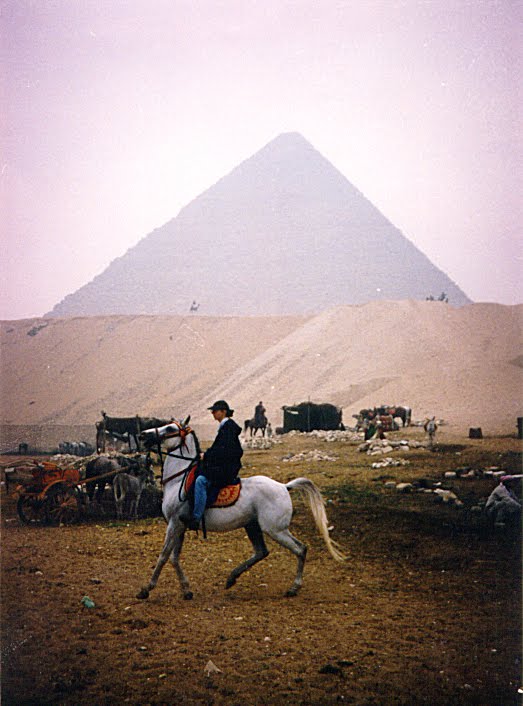
Christmas in Cairo, 1993 (Photo by Kacey Dewing)
I am intensifying my search for an agent and/or publisher, and am using this as a place to list the links for my stories (excerpts from two novels) which have been published.
The genre is creative non-fiction (a.k.a. true stories). These were all published in a handful of issues of Mused--Bellaonline Literary Review.
[Following are excerpts from Below Sea Level, novel about 10 years with husband suffering from Borderline Personality Disorder]
Shadow of the Mountains
Dog Day Afternoon*
Goodyear
Cycles
*Personal favorite
[Excerpt from The Agoraphobic's Guide to Cairo, about my year abroad in Cairo, Egypt in 1993-94]
Al-Abyaad - The White One (About the horse who did not kill me.)
-----------------------------------
Interview:
Nancy Dietrich: In Her Own Words
Further unpublished excerpts can be found on this blog:
Kickback from Below Sea Level
Painting the Town Blue from Below Sea Level
Al-Qitta (The Kitten) from The Agoraphobic's Guide to Cairo
Bustan al-Hayawanat (The Zoo) from The Agoraphobic's Guide to Cairo
Any suggestions appreciated. Thank you.
Read more!
Sunday, October 23, 2011
My Stories and Published Novel Excerpts
Thursday, April 28, 2011
My Published Stories/Novel Excerpts
Christmas in Cairo, 1993 (Photo by Kacey Dewing)
I am intensifying my search for an agent and/or publisher, and am using this as a place to list the links for my stories (excerpts from two novels) which have been published.
The genre is creative non-fiction (a.k.a. true stories). These were all published in a handful of issues of Mused--Bellaonline Literary Review.
[Following are excerpts from Below Sea Level, novel about 10 years with husband suffering from Borderline Personality Disorder]
Shadow of the Mountains
Dog Day Afternoon*
Goodyear
Cycles
*Personal favorite
[Excerpt from The Agoraphobic's Guide to Cairo, about my year abroad in Cairo, Egypt in 1993-94]
Al-Abyaad - The White One (About the horse who did not kill me.)
-----------------------------------
Interview:
Nancy Dietrich: In Her Own Words
Further unpublished excerpts can be found on this blog:
Kickback from Below Sea Level
Painting the Town Blue from Below Sea Level
Al-Qitta (The Kitten) from The Agoraphobic's Guide to Cairo
Bustan al-Hayawanat (The Zoo) from The Agoraphobic's Guide to Cairo
Any suggestions appreciated. Thank you.
Read more!
Tuesday, May 18, 2010
Kickback

Photo courtesy of Thieuthieu on Flickr
Well, they can't all be winners. This piece was just rejected by Mused--Bella Online's Literary Review. I didn't consider it (or the other one I submitted this time around) to be very strong. But it's not entirely worthless, so I offer it to you here.
Again, these are excerpts from Below Sea Level, the novel-to-be about my ten-year relationship with a charming but dangerous man. These are non-fiction, with only the names of the guilty changed. Enjoy!
**********************************************************
When Rick first introduced me to his friends Buddy and Trey, they were fairly drunk, still working on getting stoned, and flying radio-controlled airplanes out at the Bonneville Flats at the edge of Salt Lake City. Rick brought beer along, which proved unnecessary when we reached their location. They were set up better than your average Salt Lake Circle K by the looks of it—though they’d made a sizable dent in their supplies.
It was the first time I saw Rick actually look scared to do something. He was convinced he was going to crash his RC into the ground. His friend Buddy had taught him everything he knew so far, and apparently this did not yet include landing. Though Rick got his black and pink striped plane off the ground without any major mishap, he circled nervously for as long as possible as Buddy attempted to talk him down. Unless he actually aimed it right for one of our trucks, there wasn’t much to worry about. The ground at our feet was flat for miles. Apparently the danger came in the angle you chose to descend. When you are flying a hand-constructed plane made of balsam wood and contact paper, it’s fairly easy to crumple it like a piece of paper when it hits the ground. And though they weren’t made of much, they weren’t cheap. Once you accounted for the loud little engines, these babies costs upwards of $350. And took weeks to make. These are the things that make men cry.
 De plane!
At the last minute, Rick panicked and thrust his joystick towards Buddy. Buddy was still flying his helicopter—a vehicle more expensive and more difficult to fly. He handed that one to Rick, who looked even more terrified than before. His hands trembled as he worked to keep Buddy’s copter in the air and well away from the landing zone. Meanwhile, Buddy brought Rick’s plane in so light it barely made tracks in the sand. Rick quickly gave Buddy’s controls back to him and he landed that one with equal precision.
That was enough stress for Rick for one afternoon, so he headed for the beer. Buddy set his controls on the sand and joined us. He was a small man, though in fairness, most people looked small next to Rick. Buddy was maybe 5’8” and walked with an obvious limp, a result of being electrocuted some years earlier when they both worked power lines in Nebraska. Buddy was only 27 when the bucket lift he was working in lost power in the bucket. The guys on the ground were trying to get him in where he needed to be to work the lines when they misjudged and took him too close. An arc streaked from the line to the bucket and Buddy dropped from sight. Rick was watching the whole thing from the White Whale, his mechanic’s truck.
Everyone expected Buddy to be charcoal when they got the bucket lowered, but he was still alive. Badly burned, but alive. The arc cooked him from the inside out, and he was on life support for weeks. He said the pain was still almost unbearable—everything inside him hurt all the time. Rick said the lawsuit was still pending, and would probably take years to settle. Buddy never went back to power lines, choosing instead to take odd jobs re-modeling houses. Apparently he could and would do anything. Anything but electric.
Though Rick played no part in Buddy’s accident, witnessing it was enough to make him carry substantial amounts of guilt about it. He claimed the “kids” in the bucket truck were idiots and that management knew there were problems with the direct controls in the bucket. A working radio would have helped, too. Buddy never should have gone up in that piece of equipment. There were two other bucket trucks sitting in the field office, but it would have caused a two hour delay to get another one out there. The fact that they were working on hot lines meant it was already an emergency for someone, somewhere, and there was no time to waste. You could always get another guy for the bucket. That decision would be the end of the company when the lawsuit finally reached settlement.
But for now, Rick and Trey still made their money off the company, and opportunities like that one were too slim to make it financially safe for them to jump ship and look for something else. Buddy had no gripe with them, but both were uncomfortable about it, feeling it a kind of betrayal to continue working for a company that nearly killed their best friend.
Nothing dulls guilt faster than a couple of Bud Lights and a few rounds of a well-rolled joint (Trey’s specialty, apparently), so the boys were all in fairly high spirits as I sat on the edge of the truck bed and observed them observing me. For being so far removed from my usual setting—at home or a library surrounded by books—I was inexplicably at ease. Most of that was Rick. He had so much charisma that you could be a rock and still make use of the extra energy that poured out of him. And I didn’t have too much invested in what they thought of me, as I was pretty confident about how Rick felt about me.
“So Nancy is afraid of guns.” Rick finished off his beer and tossed it out onto the flats.
Bastard. Buddy and Trey turned and grinned at me. Buddy looked embarrassed. He had sounded like a nice guy, and his reaction proved it. He knew it was not nice to put your new girlfriend on the spot in front of the guys. Having spent the greater part of my childhood exchanging dares with a boy my own age in the backwoods of Kentucky, I knew exactly where Rick was headed. He had brought his .357, and he intended to make me shoot it. I would “shoot like a girl,” and his penis would magically grow three times its normal size. It was already the biggest damn thing I’d ever seen, so it was never clear to me why he needed to inflate it, but it was clearly a guy thing.
“You’ve never shot one?” Asked Trey.
“I’ve shot a couple—I tried a Colt pistol and a Glock at a range once. I sucked.”
Trey, clearly the slow one of the group, turned to Rick. “You shoulda brought your .357!”
Rick went around to the driver’s side and reached into the truck console. He came back out with a gun and a fresh box of bullets.
“Imagine that,” I said, throwing him a look that only Buddy caught. Rick was far too amused with himself to be aware of my reaction. He was already loading it, the muzzle pointed towards the salted earth.
“Trey,” he said without looking up. “Go step off thirty feet and move that can out.”
Trey trotted out to retrieve the can. He brought it back to the truck and proceeded to take thirty crooked steps into the desert. At least he proved he could count to thirty. I wondered if his house frames ever ended up on 90-degree angles. Hopefully he used a measuring tape on the job site. And didn’t measure stoned.
Resigned to my fate, I slid down the skirt of the dually and watched Rick handle the gun. It looked more or less like the Colt six-shooter, only much larger. I didn’t relish the thought of the kick it would have.
“Wait,” Rick said, as he handed it to Buddy and went back into the truck. He fished around in the glove compartment until he found a set of earplugs for me. Now the gentleman was coming out in him. As I stuffed them in my ears he took the gun back from Buddy and showed me how it worked.
“First of all, there’s the safety—right here. Slide this forward and you can’t shoot it, no matter how hard you try. So we want that off.”
Of course we do, I thought. I’d abandoned safety a long ways back. No point pretending now.
“Now, you cock it like any regular pistol—just like your little cowgirl .22 you shot before—by pulling this back as far as you can. I won’t do it yet.” He winked at Buddy.
“To aim, you use the marks on the end of the barrel. We’re not shooting far so it’s gonna travel pretty straight. You’re definitely gonna wanna hold it with both hands, ‘cuz it does have a good kick.”
“More or less than a Glock? That had a really heavy one.”
“So does this. Worse, I reckon.”
“All right. Let me have it.”
“You wanna shoot first?”
“Does it really matter what order I humiliate myself in?”
Rick flushed; Buddy and Trey laughed.
He handed me the gun. It was much heavier than the Glock, which I had not enjoyed shooting. I cocked it. It was much harder to do that than I thought, too. Too late to back out now.
“Okay—careful…” Ya’ think?! He stepped next to me. “This is a heavy gun with a very light trigger. It won’t take much pressure before it goes off, so be ready.”
I waited until all three boys stepped back before I raised it from the ground. I lifted it enough to put the beer can in the sights, took a breath, and shot. The gun jerked my wrist hard. The beer can spun and shot out another ten feet or so into the desert. I lowered the gun and slid the safety to locked. I turned back to my audience and handed the gun out at arm’s length.
“Who’s next?”
“Son of a bitch, Rick, she shoots better than you!” Buddy shoved Rick, but it was like an aspen shoving an oak. Rick didn’t budge. He hadn’t lost his cocky grin, though. I knew that was something that would only go away if surgically removed. He looked at Buddy.
“Well, I guess you better see if she shoots better ‘an you, huh?”
Buddy took the gun, slid the safety off, and stepped up to the plate. Carefully placing aim, he pulled the trigger. The can didn’t move. Rick and Trey roared.
“Sorry, Buddy. Did you want to use the .22?” Rick took the gun from Buddy, who seemed unconcerned with his performance. Rick raised the gun and shot. A chunk of salt flew up a few inches to the right of the can.
“Damn it. Better get me a .22.” He turned and held it out to Trey, who was clutching the remnant of a joint. Holding his breath, he smiled and shook his head.
“Back to you, babe.”
The first time I was so sure I would miss I had barely aimed it. I was also perfectly relaxed, since failure was a foregone conclusion. This time I felt a little more pressure. To cover for it, I made the same movements in the same period of time. The slower I moved, the more I would shake, I figured.
This time the beer can jumped about two feet in the air when I hit it. It was beautifully dramatic. I slid the safety shut again and turned to hand it to Buddy.
This time, Buddy was more measured about it. He studied the target for a bit before he raised the gun. He held his position for almost thirty seconds before he pulled the trigger. Another chunk of salt flew into bits.
“Shit,” he laughed and shook his head. “Guess I shouldn’t have been drinking the targets.” He handed the pistol to Rick, who turned sideways and spit about ten feet. He stepped forward and squinted at the beleaguered can. He lifted it in one fluid motion and shot. There was no movement at all in the vicinity of the target. This time I could tell he was irritated behind his signature smile. It didn’t seem like a good idea to me to piss off a short-tempered man carrying a large weapon—though we had exhausted its rounds.
Buddy laughed and walked over to the cooler to grab another “target,” tossing one to Trey. He nodded in Rick’s direction.
“In a second.” He was headed back to the cab of the truck. I heard bullets clinking as he fished for another round.
He came back out and headed straight for the shooter’s mark. Raising one arm, he let a shot go. The can jumped about a foot and skidded out a few more feet. Rick was all teeth. He handed the gun off to Buddy as he reached for a beer himself. He was clearly a happy man.
Buddy set his beer on the ground behind him and took his shot. Nothing. He just shook his head and handed it back to me. I walked over, raised the gun and shot. The muscles in my wrist snapped back and I had to stifle a verbal reaction. The beer can shot back into the desert like someone had kicked it at close range. I couldn’t hide my smile anymore, so I decided to enjoy it. I had no idea I could kill beer before today. This, I thought, might just come in handy someday.
Rick didn’t tease me about guns anymore after that.
Friday, April 2, 2010
New Stories Published in Mused's Spring Issue

I've been a little busy so I'm a bit late posting this, but two more unbelievably cheerful, non-fiction stories of mine have been published in the latest issue of Mused--the BellaOnline Literary Review.
Read them at your own peril.
I tried sending them some light-hearted work--I really did. Maybe next time.
Sunday, August 31, 2008
Another shot at the essay class--excerpt from Below Sea Level
“So Alex is afraid of guns.”
Eric finished another beer and tossed it on the ground. The Wasatch Mountains floated in the distance, an optical illusion from deep within the Bonneville Salt Flats.
Eric’s friend Trey, whom I’d just met, looked embarrassed.
“You’ve never shot one?”
“Just a Colt pistol and a Glock. Research for my anti-gun piece in the UW-Seattle paper. Boy, did that make me popular.”
“Too late for me to write my letter to the editor?” Eric laughed, heading for his Dodge and coming back with his prized .357 Magnum. His dare was unspoken but he knew I couldn’t resist. That drew him to me; my inability to resist a dare, regardless of what I believed was right. That was Eric, a walking dare.
“Trey,” he said, “step that can off thirty feet.” Trey took thirty uneven steps into the desert. He jogged back. It was cool for a June evening on the flats, but he looked warm.
Laying the gun on the grey suede seat where I’d accompany him home, Eric fished out three sets of hunter orange earplugs. He turned to me.
“Okay, here’s the safety. Slide this forward and you can’t shoot, no matter what. We want that off.”
Of course we do, I thought. I’d abandoned safety the day I met you.
“You cock it like any pistol—just like your cowgirl .22—by pulling this back as far as you can.” He winked at Trey.
“To aim, use the marks on the barrel. We ain’t shooting far so the bullet’s gonna travel pretty straight. Hold it with both hands, though, ‘cuz it does have a right good kick.”
“More or less than a Glock?”
“Worse, I reckon.”
I stretched out my hand.
“You’re shootin’ first?”
“Does it matter what order I humiliate myself in?” Eric flushed; Trey laughed.
Eric handed me the gun. It was heavier than the Glock. I released the safety and cocked it.
“Okay—careful…” Was he was worried about me or the gun? “This is a heavy gun with a very light trigger. It don’t take much pressure to go, so be ready.”
I found the can in my sights, held my breath, and pulled the trigger. The gun jerked my wrists, hard. The target spun and shot out ten feet. I slid the safety on and held it out at arm’s length.
“Next?”
“Son of a bitch, Eric, she shoots better’n you!” Trey shoved Eric, but Eric didn’t budge. Didn’t lose his cocky grin, either. That would go away only if surgically removed.
“Well, I guess we better see if she shoots better’n you, huh?”
Trey aimed carefully before taking his shot. The can didn’t move. He groaned.
“Sorry, man,” Eric said. “Did you bring your .22?” In one movement, Eric took the gun, raised it confidently, and shot. A chunk of salt flew up just inches from the can. Hit or no hit, I was impressed.
“Goddamn. Better get me a .22. Back to you, babe.”
The first time I knew I’d miss so I barely aimed. I was relaxed, with no expectations of success. Now, there was pressure.
This time the can jumped two feet in the air. Beautifully dramatic. I handed off to Trey.
“Shit,” he said. “I drank too many targets.” He passed off to Eric, who turned his head and spit out his Copenhagen. Stepping forward and squinting at the beleaguered can, he shot. The can sat undisturbed. Not so, Eric; though he worked to conceal it.
Taking more bullets from the pocket of his loose-fitting jeans—he was so lean that summer—he reloaded. Raising one arm, he shot, out of turn. The can jumped a foot and skidded out several feet. Eric was all teeth, smiling up to his brilliant blue eyes. His mustache twitched in delight.
Eric laid its weight in my hand. I raised it and shot—one-handed, like Eric. The muscles in my wrist snapped so violently I stifled a cry. The can shot into the desert as if kicked at close range. I no longer hid my delight. I had no idea I could kill beer before today. This, I thought, might come in handy someday. Eric hugged me close and rested his head on mine.
Roaring out of the flats, I grew fixated on the knowledge that these thirty thousand acres once hosted a lake the size of Lake Michigan—full of life. Hard to imagine that nothing would ever take root here again.
Read more!
Tuesday, August 26, 2008
Essay Class: Characters

I have stayed with the same theme--characters and scenes from Below Sea Level. There is a method to my madness, and it is finishing this book, finding an agent, and finding a publisher. Piece of cake.
1. Write a description of someone you know, exploring the person’s positive and negative personality traits.
Eric slammed his right fist into the roof of the truck cab three times, hard and fast. The truck veered sharply over the center lane, and I grabbed for the wheel. My hand met his arm, solid as the steel he welded every day. Every vein stood out against his sunburnt muscles. The fuel gauge read empty, and we were barreling down Interstate 15 at close to 80 mph.
“That was the last Flying J,” he screamed at the windshield. “And now there’s not a goddamn thing for another 46 miles.” More fists into the roof. “We are fucked.”
We were driving to Utah to visit a fellow Texan, and only halfway there. His boss paid for gas at Flying J’s, but nowhere else. Eric had refused to stop elsewhere, and now we had nothing. He was in such a rage I was convinced he’d run us off the road, kill us both.
“Pull over at that stop,” I said, with as much force as I could.
“It’s not a fucking station; I can’t waste what I’ve got.”
“Pull over or I jump out of this fucking truck.” I was terrified, and had only anger to hide it.
He pulled over. I jumped out. We were officially nowhere, not another soul in sight. Every muscle screamed against my getting back into that vehicle with him. Let him leave me here, I told myself. Someone would come eventually. Maybe someone even crazier. Jesus Christ, I was in it deep. I’d known this was possible and still I’d come, to be “shown off” to his friends who’d never met me. After ten minutes of pacing, I returned. Eric was studying the map between the bathrooms. When he wheeled around, he was smiling. He walked back to the truck like he hadn’t a care in the world. For a moment he looked confused at my anger.
“There’s actually another stop in ten miles. It ain’t no Flying J, but it’ll hold us ‘til we find one. Don’t worry; I’ll still make those fuckers pay for it.”
Well thank goodness for that, I thought.
Later that night, as I waited for him to join me in the guest room, I seethed—at him for endangering us, and at myself for allowing it. I still heard loud voices, so I slipped down the hallway. Eric and Dan were comparing stories; the boasts, laughter and profanities flowing as heavily as the beer. Eric in his element. Then, I heard them pause, and a gentle clinking. Bested by curiosity, I crept in and saw them, three of them, arranged around Dan’s coffee table. Dan’s four year-old daughter had just poured the men another round of “tea.” I watched Eric lean over and thank her—so gentle, so genuine, his smile as wide as the rack of a Texas Longhorn. Then both men, still holding their tiny cups as delicately as any débutantes, resumed their rough-and-tumble conversation. I fell asleep smiling.
2. Write an additional 250 words giving a physical description of the person you wrote about.
Eric was leaning against my car when I got home. I could tell it was him because I felt my knees buckle slightly before I even got close. He had one leg crossed over the other as he juggled a Big Mac, and didn’t notice me sizing him up.
Man, he was something else. His t-shirt and jeans were covered in oil and dirt, but you could easily make out the man underneath. His black hair was tousled and he was fighting to keep his Texas handlebar out of his burger. I never knew wiping your mustache on your sleeve could be so sexy. I felt like I was walking into a tawdry romance novel. I was walking into a tawdry romance novel.
He gave a quick nod as he saw me, and straightened to his full 6’2”.
“Need a hand here, Ma’am?” he joked. His eyes stood out in the boldest blue, backlit by the clean patches on his face.
“It died again.”
There we were, the cheesy stereotype: helpless little lady with her piece-of-shit car, and strong, competent, mechanic ready to save the day. I felt so vulnerable, though we’d already met, dated, and decided we weren’t compatible. What the hell was I thinking? Whatever it was, I forgot it by the time he got the car running. I was weak, but not stupid. Men like this didn’t just drop out of the sky for women like me.
This was one novel I could not put down.
3. Write a description of yourself, exploring your positive and negative personality traits.
Read on, if you dare.
I am a woman determined to survive.
As a child of twelve, I faced a broken family; a timid father coming out after a lifetime of denial, and a devastated mother hiding her grief by fleeing to nursing school. In their time of pain and turmoil, they needed a good kid, a quiet kid. I couldn’t do much, but I could do that. As a child of fifteen, I faced a school for rich kids in my worn-out clothes, cartoonish buck teeth, and back brace, all with a pathological shyness. The teasing was indescribable. But I was a good kid, never bothering Dad as he built a new life, never pulling aside teachers who were so kind and so busy, and never, ever lashing back. That much I knew: Hurting others is wrong, even if they hurt you first.
At eighteen, recovered from my physical deformities but still lacking any social skills, I became a professional college student. It was structured, it was sheltered, and by God, I was good at it. I lived on the praise of my teachers, and bothered no one. At twenty-four, the first love of my life found me—and I lay crushed like a penny on a railroad track when it ended two years later. Back to school I went, this time taking a fellowship in Cairo, Egypt, to prove just how courageous I was. I lived there a year, proved my point, and came back for more.
Nearing thirty, I lost my bearings when my social stigmatism short-circuited my Ph.D. Floundering financially and socially, Eric found me. Overnight, I became a star. To a tough young Texan who’d built a life on nothing but sweat, blood, and endless charm since early childhood, I was his renaissance woman. (His words, not mine.) In me he found a woman who never uttered a word to offend, never judged when witnessing his first bouts of alcoholism and, most importantly, wore her education quietly, not pompously. And he excelled where I did not—financially—thus we discovered a partnership made in heaven. Balancing our strengths and weaknesses, we would survive together.
But our union was nothing more than an act of desperation. In our fragile states, we simply pulled each other deeper under water. The harder I swam, the heavier the weight I bore. I shouted out directions so he could swim beside me, but I was not heard. So, I learned to let go. Going forward alone felt utterly purposeless, but I slowly began to understand the importance of one’s own life. As I swam, and breathed, I survived witnessing the slow death of a man I still loved deeply, who had unquestionably made tremendous sacrifices for my happiness. I watched in surprise as we each made our way to opposite banks of the lake we’d navigated together for years, gave him one last look, and turned to find my own path.
I am a woman determined to survive.

Monday, August 18, 2008
The names have been changed....
The Writers Online Workshop Personal Essay class has a little more bite to it. That's why I like it. I looked forward to all the assignments and found several that made me say "I can't do that." That's when I knew I needed to take the class.
The first assignment was as follows:
1) Choose a “first” in your life—a first kiss, a first communion, a first parking ticket, a first marriage, etc.—and write up to 500 words describing what happened and how you felt about it at the time it was happening. 2) Write an additional 250 words discussing how you feel about that same experience now, through the lens of hindsight.
For this one, I chose a chapter from Below Sea Level and took it from 3,900 words to 750. It was like moving all my belongings from my two-story house into my one-car garage. I think I will post the full chapter here as well (give me a day or two) for comparison.
Click on Read More for "First Commitment."
At 7:15 a.m. in the morning, adrenaline coursing through my veins like Turkish coffee, Eric climbed into my truck and we headed for Idaho Falls. The silence in the cab was deafening, so I reached for the radio. The Rolling Stones’ “Nineteenth Nervous Breakdown” was just beginning. God has an unrivaled sense of humor.
“Do they know we are coming?” he asked.
“Yes.”
“I’m supposed to be at work—”
“I’ll handle it.”
I had called the hospital at 4 a.m., an hour after I was convinced my husband was dead to the world. They expected us at 8 a.m.
I lost count of the drunken episodes in our years together, but that night was the worst I’d endured. He was delusional, paranoid and, I believed, having a nervous breakdown. I didn’t think he, or I, could survive another one. My anger finally trumped my fear, and when he was hung over and groggy at 7 a.m., I gave him two choices: Watch me leave, or go in for treatment. Could have gone either way. I had no idea where I’d go in a pickup with two dogs, a cat, and four guinea pigs, two thousand miles from family. I desperately needed him not to call my bluff. Thankfully, he did not.
Anyplace else, I’d have taken off when he started ranting against me, against the world, against himself; but that summer we were set up in an RV at the foot of the Grand Tetons, so unless you were a pack guide with a good rifle, there was nowhere to go at night without risk of attack by bear, mountain lion, or even wolves. After hours of “Fuck you!” all these possibilities started looking better than the situation I was in.
Shortly after eight, we pulled into the emergency room parking lot. Eric was still as death, yet alert as a rattler. I was shaking so hard at the reality of committing him I dropped the keys on the floorboard as I shut off the motor.
Two large men checked him in. They made him hand over everything which defined him: cell phone, massive key ring, some guitar picks, the hunting knife he always wore, and his Copenhagen. That was the only time I saw anger flash in his eyes. He relaxed after they assured him it would be kept behind the nurses’ desk.
I had never seen him unarmed, defeated, and I felt an overwhelming sense of shame at humiliating him publicly. This I had not expected. The man had disappeared, leaving only the child abused and abandoned so long ago. I felt criminal, and began to lose my resolve.
“It’s okay, babe,” he said. “You did the right thing.”
I collapsed into the nearest chair, pulling my knees to my chest just as I had all night long. I soon got looks from the staff indicating they were no longer sure who needed hospitalization more. They were right, and it was the first time I saw it myself.
****************************************************
Eric stayed a week at the hospital, and I slept better than I had in months. Together in counseling at the hospital, we heard the diagnosis “Borderline Personality Disorder” for the first time. It gave me hope—he had let himself be admitted, we had a diagnosis. He was finally going to get the help he needed…
It took fifteen months before the next hospitalization. Twelve until the next. I became an expert liar, covering for his job by fabricating stories about his dad’s sudden heart attack, etc. He’d do well for weeks, then run out of whichever drug they prescribed him (which he would always wash down with alcohol) and we’d be back at ground zero. I grit my teeth on such a regular basis I am surprised they survived the relationship.
Though it is unfair, I still blame myself for not having the strength to load up my truck and leave him in his drunken stupor that night (or any other night); yet, at the same time, I am proud when I remember taking that first step towards self-preservation, even if it was in the context of taking care of him. Just as you don’t fall into an abusive relationship overnight, nor do you escape from one in one night. Stepping out from under the shadow of the mountains is sometimes the most you can do, and it’s the only way to learn to become your own pack guide.
Read more!
Saturday, November 3, 2007
10.6K down, 39.4K to go
 My muses, SodaPop and Ginger Ale, under the table by my computer.
90,000 mad-dog novelists have finally succeeded in crashing the NaNoWriMo site. Frankly, I'm a little disappointed it took three days for us to do it. We obviously weren't trying hard enough.
Since I can't post my word count there tonight, I will post it here. 10,693. That's about 4,000 words ahead of schedule. Don't worry, I'm already having shades of a nervous breakdown and we haven't even hit one week. I'll be crossing the finish line writing my closing lines on a mirror using lipstick at the local prison, I guarantee it.
Come to think of it, I had better buy some lipstick.
I'm not kidding. This shit is messing with my head. I woke today at 8, got up, fed the dogs, ate breakfast, walked the dogs, walked into my office, walked out of my office and into my bedroom, and got back into bed.
It wasn't all sleep--there was a lot of pep-talking going on. It just wasn't helping. (And no, it wasn't from the dogs.) I spent hours Friday night reliving a couple of very bad days--I mean creating fresh fiction from off the top of my head--and it was only normal to expect I might have a small hangover the next day.
At lunchtime I got up to walk the dogs again. Then I came back in and sat on the edge of my bed. Both dogs immediately jumped up and curled up for another nap. That's what got me up--the fact that even my dogs had lost complete faith in my ability to keep going. Soda's gaze was especially hard to bear as she was a main character--I mean, basis for a completely fictional character--last night, and she seemed to be faring just fine, thank you.
Now I was up, but I still couldn't go into my office. I needed another option. I threw on some riding clothes and drove to Sun Prairie. Research, I told myself. There will definitely be horses in this book at some point. So Julian and I took another healthy gallop around the empty corn fields. Julian must have been battling some demons himself, because he ran hell bent for leather a few times. During one sprint I had to just ride him out until he was too tired to keep going. I tested the reins mid-way, thinking he was overdoing it, and there was nobody home. Julian channeling John Henry, another old sprinter.
I don't know why, but the more he runs like that, the more I want to get on a thoroughbred. We always want more, don't we? I love my Percheron racehorse. And this time, I made sure to give him something to help with sore muscles before I left. We'll see who's limping worse tomorrow. Read more!
Monday, October 15, 2007
Dog Day Afternoon
[This is another excerpt from my novel Below Sea Level. It is not for children, and it is not light reading.]
Standing over the dead body of the dog that meant more to us as a couple than any other animal we had yet to own, I am not believed.
We are burying Sage—a Dalmatian-Brittany spaniel cross I had rescued eight years prior that Eric grew to love as one would love a child, loved in certain ways more than me—under a circle of pines and the ever-shedding Eucalyptus tree, to protect her forever from the wicked Arizona sun. But there are roots, and they are making the process difficult—close to impossible. We are both taking turns in the desert heat of early May, but we are getting nowhere. A hundred degrees and the humidity of recent irrigation make us feel like we are laboring under water. As we work, our living dogs, Rosemary and Thyme, are getting worked up. Thyme is running fast and furious circles around the makeshift gravesite. Rosie has stopped running and has settled her slight figure just next to where I stand waiting for my turn to dig. She is trembling as she sits awkwardly, looking as if she might take flight any moment, and moves her gaze rapidly between Eric, me, and the body of her dead friend. She needs reassurance and there is no one available to give it. I have always anthropomorphized my smallest canine companion and, as a result, I can’t even bear to look down and see the expression I know is on her face—a wrinkled brow, a question. I reach deeper in my pockets for Kleenex I know I’ve already used up. I am trying to imagine how I can withstand the death of this dog on top of the omnipresent pain of my dying marriage. It is unimaginable.
As Sage lies next to the shallow depression rent with roots of a gnarled 50-foot pine, Eric snaps the handle of the old shovel we have been using. “Motherfucker.” He throws the handle across the yard. Thyme pauses for a moment before resuming her circles. “I’m going to Clint’s.”
Our retired neighbor Clint had a tool for everything—he’s the only man we know with a more diverse set of tools than Eric. He’s been building and rebuilding his farm for twenty-odd years, and a man raising children and then draft horses can accumulate a lot of useful equipment in that amount of time. I stay behind with Sage and with Rosemary, whose gaze I can feel moving repeatedly from Sage to me and back again. Mostly to avoid her gaze, I wipe the sweat from my face and neck with my shirt and start digging out dirt with my hands from between the roots that criss-cross Sage’s grave. Thyme, only five months old but already outweighing Sage’s fifty pounds, runs aimlessly through the trees, tossing her toys and then chasing them down, and stops only briefly to sniff her still companion from time to time. Thyme is not confused, because she is not aware. She is, however, panting heavily, and I worry briefly about her overdoing it in this heat. I don’t call her over, though, because I don’t need more complications.
Clint’s place is only three acres away, and I can actually hear something metal clang when Eric finds it and throws it in the bed of his truck. No sign of Clint. Eric will be relieved not to have to share his current mental state with him. Knowing Clint, he would have followed Eric back, and what couldn’t possibly become more painful and awkward would have. Eric is already on his way home—he is backing slowly all the way from Clint’s since the irrigation canals leave no room for Y-turns with a Ford F350—when my cell phone rings. I can’t believe that I pull it out to bother checking the number, but I do. It is my sister, Sam, calling in from across the country, probably with a funny story to tell. The pain is too much to carry alone, and I answer the phone. My voice is low and my nose is beyond stuffed up from sobbing, so she knows immediately there is something wrong.
“Sage died today.” I hear her gasp and feel guilty instantly for sharing this pain with her.
“I came home from work and saw that Eric hadn’t opened the dog door yet to let the girls in. He must have only been home a few minutes. I went out on the back porch and there she was, lying on the floor of the Arizona room.”
I hear Sam say something unintelligible. She is crying. It has been less than a month since she has thrown a ball for Sage. “I assume it was a heart attack. I don’t know.”
Sage had been coughing a congestive heart failure type of cough for months, now, and stopped being able to bear anything more than a twenty minute walk a few weeks back. At the time, I had mistakenly and naively figured she probably only had a few years left, and grew saddened at the thought. And last week, she was uncharacteristically clingy, wanting to be the lap dog she used to be. We couldn’t figure it out at the time, but it made a lot more sense now. When I found her that afternoon, she lay stretched out on her right side on the cool cement. I felt sick that she died on concrete and not on carpet, or grass, or her blanket, which was hanging on a line in the backyard to dry from being washed the night before. Her tongue was lavender in color, and spilled onto to the floor like some caricature of a dead dog. She was slightly warm, but only from the heat of an Arizona shade. Judging from her stiffness I figured she had died around lunchtime.
I don’t tell Sam about the coughing, the lavender tongue, the stiffness. She is crying hard now. We are both useless. Eric’s truck pulls back in to the drive. “I have to go. Eric needs my help.” I have ruined her evening, no doubt.
I am still crying as Eric brings over what I think is called a maul, but decided against asking to be sure. Anger has possessed Eric, and I’m jealous he’s found a way to not feel the pain, if just for a moment. He starts to attack the buried tree limbs with renewed energy, and I find myself surprised that he has not asked the identity of the caller. He was walking towards me as I closed the phone, wiped the dirt from it and put it back in my pocket. It is second nature to both of us that I should be quizzed on who would be calling me. He is ever convinced that I am being pursued by someone, anyone, who will treat me better than he can. Reassuring him that this is not the case is a full-time job. I find his lack of curiosity so unusual I tell him without his asking that Sam called, and we were both crying so badly we had to hang up. He continues to work in silence, the occasional dry sob escaping him.
It is now very warm, I’m-going-to-be-sick-and-pass-out warm, and I struggle to keep up with Eric, as if I ever could. Used to working outside all day, every day, even he is exhausted, and sweat covers his face, neck and chest. He shed his shirt long ago. He keeps resting on the handle of the maul as if he’s short of breath. Seeing him tire is unnerving because it is so rare, and I have to pull the tool from his hands—and his angry eyes—to get him to release it to me. I can feel his impatience as I make ridiculously little progress, and let him take possession of the tool after only a few minutes.
After roughly thirty minutes, we have made it about three feet down. I am worried it is not enough, but he says it is, and I defer to his assumed previous burying experience. I also know better than to argue with a deeply grieving, unstable man holding a 20 lb piece of iron. We both look at Sage and try to accept what we are about to do to her. He initially tries to shake me off when I reach for her at the same time, but relents and lets my arms join his under her body.
Lowering her into the cool bed we have created for her is excruciating, and my eyes close rather than risk meeting Eric’s above her as we hold her together. It is at this point I become aware that I am not able to feel my own grief because I am so overwhelmed with his. In some way this seems unfair to Sage, and I briefly find the energy to be angry with Eric. We have just laid her to rest when Rosemary flies without warning into the hole with Sage. Now her imagined grief washes over me too, and I am undone. Eric turns away and begins to cry once again. In my mind she has figured out what we intend to do, and she is horrified and confused. Whatever her true thoughts, she is undisputedly distressed. I scoop her into my arms and hold her as she scratches to be let down, now crying out with a high-pitched call. I set her on the edge of the grave and tell her to stay, and she does, eventually switching her gaze from my worried face back to Sage. Her face is now one tragic question. Eric and I find Sage’s favorite toys which lay scattered about the yard and lay them with her. Thyme perks up when she sees us collecting toys but retreats at Eric’s look. I am reaching for the broken shovel when Eric says, rather frantically, “Wait. She needs a tennis ball.”
I hold my breath and wait for him to find one and lay it between her paws. Death would have been preferable to witnessing this death of a friendship—maybe his only true friendship. Unable to put it off any longer, we begin to fill the hole we worked so hard to create just moments before. When we have returned all the dirt we had removed, we start collecting rocks from around the farm to lay them on the mound we have created. We have spent years clearing rocks from all parts of the property, yet for some reason we cannot find enough of them to do her justice. While Eric searches in the back of the property, I go around to the front of the house, to my flower garden. It is not a garden now—the heat, the gophers and my depressed indifference have killed its beauty weeks before—it is nothing more than a crescent-shaped piece of earth surrounded by heavy and variegated stones I have put there over the course of the previous months.
One by one, we move them to the backyard for Sage. We pile them on her to keep her safe from anything that would dare disturb the peace she has earned from her eleven years on this earth. I feel I could kill a marauding coyote with my bare hands should I catch one defiling her final bed. Rosie has gone back to playing with Thyme now, and seems reconciled to her loss, and I envy her desperately. The same cannot be said for Eric. He asks me to be left alone with her, and I gladly retreat. I try to stay occupied with the chores I have yet to complete. A few hours pass and darkness falls. No one eats, but Eric drinks interminably sitting in his office, multiple beers lined up in front of him to save him the hassle of getting up and down every few minutes for a new one. He easily downs 9 or 10 in the first 90 minutes.
On edge from his drinking but unable to stand the sight of him bearing this alone, I go and sit with him in his office, where he sits quietly. He has been there for hours. A few moments after I join him, he sets his beer down on the desk before him. He does not raise his eyes.
“Who really called today?”
I am caught completely off-guard, which in and of itself catches me completely off-guard. I am astounded that his fear has percolated through the pain of this loss to aim for me. Why should I have been surprised? We did not experience emotion even remotely the same. This had sent him God knows where, and I had lost his trail in our combined grief.
“I told you while we were outside.” Was he really questioning my honesty while burying my own dog? I could not believe that. Not even from Eric. There had to be some mistake. “Samanatha called while you were at Clint’s, and I hung up when you drove up so I could start helping you dig again.”
“There is no record of her call on your cell.”
This cannot be happening. This cannot be happening on top of the devastating death of my dog. I have wandered the house and yard for hours, trying to find a place for the pain, and trying even harder to find a place for his, and he has found time in his mourning to double-check the record of incoming calls on my phone.
That fucking phone. How many times had I wished I had left it lying in the weeds when he threw it out of the RV in Idaho during a drunken rage years ago? It had brought me nothing but hell. It was nothing more than a monitoring device he may as well have buckled around my neck the day I got it. Just the sound of it ringing—and I initially typed “wringing”—was now enough to double my heart rate, just anticipating the next tirade he was calling me with; or worse, fearing a wrong number that would lead to an endless, meaningless interrogation when the phone bill—with all its errantly damning numbers—came in the mail. I wished fervently that I had dropped it in the ground with Sage before we heaped the dirt back upon her.
These thoughts occupied the space of a second. Within two I was out of my chair in search of my phone, unwilling to stand falsely accused by a technical glitch.
“Sit down,” he said. “It doesn’t matter.”
It mattered. One more time, Eric had taught me that just when I was convinced there was no room inside of me for any more grief, there still was. My grief for Sage was torn now with renewed grief for us. I should have handed the phone to Eric while Sam was still on the line. I shouldn’t have answered at all, and she’d have left a message. I should have left the phone in Idaho… I left his office and went to Sage. I cried in anger now. How could a dog so loyal leave me alone in this life? Rosie crawled into my lap in the darkness, and together we cried.
Read more!
Monday, September 24, 2007
Painting the Town Blue
[The following is an excerpt from my novel, "Below Sea Level." Though the setting will seem familiar to some, the actual events in this story are fiction.]
One day, without any real forethought, I stopped at the Home Depot on the way home from work and bought two cans of brightly colored spray paint. They keep that aisle locked at the store, so I had to wait a few minutes before someone was available to open it. The clerk did not ask me what I needed the paint for. I suppose I looked innocent enough. Not the profile of a sniffer, gang tagger, or anything remotely like that.
The cans rolled back and forth with each other in the passenger seat of my car, competing for center position. I stayed focus on the small highway leading to the farm, as more people died there each day than died from skydiving without a chute. Fifteen minutes brought me to the house. Eric’s rig was not visible, nor was he expected from his job for another few hours. I pulled into the drive and parked as usual; then changed my mind and turned the car around so it was facing the driveway. Eric had once referred to this as “combat parking.” Sometimes I just needed that little extra kick of safety. I had also fooled myself into thinking it saved me precious seconds on driving into work the next day, not having to back out and turn around. Logic was never my strong suit.
I grabbed the cans on my way into the house, where I was greeted by a bevy of hysterical dogs and a flock of recalcitrant cats. Leaving the cans on the fireplace mantle, I undertook my usual series of chores: feeding the hounds and tigers; checking on and feeding the guinea pigs, making sure to throw them a few fresh carrots or orange slices; and lastly, mixing together a small coffee can of sweet feed and supplements for the horse and carrying it out to him along with a few flakes of grass hay. Watching him pace along the fence, or take off kicking his heels up in protest at being the last to be served was always the highlight of my day. I slid his feed tub under the fence and tossed the hay in beside him. As was my habit, I leaned against the fence and watched him eat for a few minutes as I filled the water tank back to overflowing. After turning off the water, which I really only seemed to remember to do about nine out of ten times, I returned to the house, where the dogs had long finished licking each others’ empty bowls. The cats had retreated to their usual hiding and sleeping crannies, and I was free to use my time as I pleased until Eric came home and dinner might need to be prepared.
I had changed out of my work clothes before heading out to see the horse, so I had nothing left to prepare other than the removal of a handful of framed photos decorating the front room of the house. Not even the nicest of pictures did much to enliven the aged paint job of this old house, so their removal did not take away much, either.
Without looking at which color I was choosing, I reached behind me for one of the cans of spray paint. As I shook it vigorously to and fro, I glanced out the front door window to make sure my retired neighbor hadn’t decided that this would be a good time to stroll over with his Labrador and get me caught up on local gossip. No sign of him, so I turned to my canvas. In large blue letters, I wrote, “I have never broken my vows of marriage” on the wall one saw first upon entering the house from the front door. It was more satisfying than I had expected. Writing is like that, sometimes: once you get started, you just feel like writing more. Cathartic.
I shook the can a little more and moved to the wall with the small front window. Next to it, I wrote, “I have never slept with any of your friends.” As an afterthought I added below it “or your enemies.”
I still worried I was not being specific enough, so I set the blue can back on the mantle and reached for the orange. I shook it for the recommended period of time, and continued. I moved back to the largest expanse of wall. I tried reaching up higher so I would have more room to utilize. “I have never dreamt of canoodling with Tom, Dick, Harry, or anyone else you have ever worked with. (I stopped to paint a nice illustration to go along with "Dick.") I have never screwed any employer I have ever worked for - male or female.” I felt like I was finally starting to lay down the proper specifics. Still, the mostly bare walls of the adjoining family room beckoned. I now had one can of paint in each hand.
“I have never used my phone for illicit conversation with any individual. I have never lied about the identity of the person on the other end of the line—EVER—nor have I ever had reason to.” I was running out of blue paint. I set it down and re-shook the orange. What was I missing? His office.
Not much room to spare in there, but somehow I managed to make my message small enough to fit. “I have never used our computer to share romantic e-mails with anyone at anytime since we have met.” That one came out particularly well, I thought, though near the end I did get a little paint on one of his framed contractor licenses. I had just a few dregs of paint left. I walked into our bedroom and climbed up on the bed. Above it, I wrote, “I do not cheat on my husband.” Near the end it trailed off as the can became spent. It was still readable, though.
Damn it. I had managed to get a fair amount of blue and orange paint all over my thumb and forefinger. It was going to be a real bitch to get that off. Irritated with myself, I threw the cans into the kitchen garbage and walked out into the backyard to distract myself with the dogs. There were some lingering fumes in the house, and I didn’t see any need for the girls to get sick from them. I tossed the ball for them until I heard Eric’s diesel pull into the front drive. I stepped back towards the back door and quietly slipped the doggie door into place so he would not be completely overwhelmed by what awaited him in the house. As satisfying as my work had been, my heart now pounded like Poe’s Tell-Tale Heart. I had already placed my car keys in my pocket, and I felt them again to make sure they were still there. Soon enough I heard the front door open, then complete silence.
After a few moments, I heard him close the front door gently. His movement across the carpet was noiseless, but I could make out his broad silhouette moving through the front room into the family room. He stood there for several full minutes. Surely he could hear my heart all the way from inside the house by now. It was as loud as church bells. Finally, he turned and entered his office, where he fell back quietly into his chair. He dropped his enormous collection of keys on the desk in front of him, and then dropped his hands onto his lap. I had moved to where I could still see his outline, and I watched as his head dropped back against the back of the chair. I could not see them, but I imagined his eyes had closed.
I had brought collars and leashes out back before he got home, and I thought this was as good a time as any to take all the girls for a short jaunt around the neighborhood. May very well be the last walk I lived to give them, for all I knew. It began to occur to me that I had gone completely insane. Would he call the police, or the hospital where we had taken him for help earlier that year? Only time would tell. One thing was certain; bravado fueled by anger was rapidly giving way to fear fueled by experience.
Darkness eventually drove the dogs and me back home, as the only thing we were more frightened of than Eric was an errant pack of hungry coyotes coming out of the Arizona hinterland. When we entered the house, the dogs all ran for the office, where he still sat. I heard him greet each of them separately, then fall silent once again. The dogs quickly filed back out into the main room, as his mood was clearly palpable to each of them. This did not bode well for me, but little had for some time. I walked slowly to the doorway of his office and leaned against it, keeping just enough weight on my feet that I could still get the hell out of Dodge pretty quickly, if I had to.
He did not turn his head to look at me.
“Bad day?” he asked.
“A few,” I replied.
“I am not painting these walls.” Well, why would he? I was the one with so much to say, apparently. I quickly realized that was not what he meant.
“Of course not.” I said. So far my heart had not leapt from my chest, which I considered impressive. “I have a three-day weekend coming up. I planned to paint them all then.”
He seemed mildly startled. “You’re not finished, then?” He still hadn’t looked in my direction, for which I was grateful. His black-brown eyes would have brought me to my knees.
“No. I mean, yes. I mean, I had been planning on repainting the walls before my family came out again, anyway.”
“That would probably be a good idea,” he said. He remained quiet for a few minutes and I thought I sensed my opportunity to escape. I straightened up as if to leave, when he began to speak again.
“I never said you had slept with anyone.”
He had in fact spent several drunken years accusing me of all kinds of traitorous activities, but arguing with Eric - even a sober Eric - was a futile experience. He was not likely to remember that he had, in any case. He had an unusually good memory, but a highly selective one. I did not bother to reply.
“It’s them I don’t trust—not you.”
“I wish that were true, but it is not," I said. "You trust no one, except maybe the dogs. Even as I wrote all these things, I knew I was wasting my time, because you’d still never believe me.”
“Didn’t stop you from doing it.” He turned to face me, and I used the doorjamb to brace myself against his gaze. Though he was showing only a fraction of it, his anger sucked all the breath from my body. My next words were barely audible.
“I guess I reached a point where nothing would have stopped me from doing it.”
I turned to leave. “I don’t need any dinner tonight,” he said, as I walked away.
Neither would I. I felt like doing nothing more than leaning my head and shoulders over the toilet and vomiting blue and orange paint into the bowl. I had rendered myself sick. Still, in the depths of my shameful soul, there remained a part of me that jumped joyfully up and down, delighting in her unexpected and splendiferous crime of passion. A small smile escaped me as I walked out into the front room, but I just as quickly swallowed it again.
Eric turned in early that night, forgetting even to drink, not mentioning the final words under which he rested his head. I waited until I could tell by his breathing that he had truly fallen asleep, and then joined him and the dogs in what little space remained in the bed. That night, I had my first dreamless sleep in about six months. When I woke up, my eyes darted to the walls around me. They were completely white.
Read more!